How many kinds of vegetables do you buy? All kinds indiscriminately or do u end up getting the same set week after week? Do you get excited by new veggies in other households? Do the experimentally bought veggies get relegated to the back of the drawer and only resurface during fridge clean up? Do you stereotype veggies as mallu, gujju, punjabi, marathi etc? Do you feel that certain vegetables taste like a particular cuisine no matter what you make with it? I am as guilty as you are and the only reason I can think of is environment. We tend to attach foods to a weather, a place, a cuisine that we first ate it in, a way of cooking...and to break out of that mold is difficult.
December 02, 2009
Beans Carrot Mezhukkuparatti or Stirfry
How many kinds of vegetables do you buy? All kinds indiscriminately or do u end up getting the same set week after week? Do you get excited by new veggies in other households? Do the experimentally bought veggies get relegated to the back of the drawer and only resurface during fridge clean up? Do you stereotype veggies as mallu, gujju, punjabi, marathi etc? Do you feel that certain vegetables taste like a particular cuisine no matter what you make with it? I am as guilty as you are and the only reason I can think of is environment. We tend to attach foods to a weather, a place, a cuisine that we first ate it in, a way of cooking...and to break out of that mold is difficult.
July 03, 2007
Kaya- Payar Mezhukkuparatti/ Plantain w/ Long Beans

I am still on my veggie kick so here is another easy to make vegetable which is a lighter form of the traditional mezhukkuparatti or stirfry. I guess it would take a whole sadya(a Kerala veg meal) to satisfy me now, but with my mom on the other side of the country,(on vacation there now) have to settle for a single dish.
Mezhukkuparatti literally means coated with oil, wheras thoran is any vegetable cooked with crushed coconut in it. We used to call all our dry vegetable side dishes as upperi, but in other parts of Kerala it is distinguished as mezhukkuparatti and thoran based on the type of preparation. And they define upperi as chips. Upperi is prepared from various things like raw bananas (kaaya), yam (chena), jack fruit (chakka), bitter gourd (pavayka) and egg plant fruit (vazhuthanga). Slices of the ingredient are fried in coconut oil to a crisp condition. Yum!Yum!
So anyway, my intention was not to sidetrack and cause tidal waves of salivation. This recipe is the way some vegetables are made at my house. Not stirfried, and not with crushed coconut. The vegetables are steamed/boiled with a little water and tossed with a seasoned oil, which acts as a dressing. Its quite similar to the tossed green salads, at some restaurants, seasoned with a hot spicy oil poured over greens to wilt it. Probably this was done to retain most of the nutrients of the vegetables and to balance the rich preparations of the meat dishes. Though made as a side dish with rice, I end up eating it in lieu of salad or a mid day snack.
You will need:
Raw Green Plantains – 1
Yard Long Beans-1/2 bunch
Whole red chilies-2
Turmeric powder- 1/4 tsp
Red chili powder- 1/4 tsp
Curry leaves- One sprig
Salt – to taste
Oil(preferable coconut oil) -1 tbsp
Preparation:
Peel the green plantains with a peeler, removing only one layer. Cut into 4 chunk pieces and then further cut each piece into 8-10 thin long segments. Soak the pieces in a bowl of water with a pinch of turmeric for about 5 minutes and then rinse it well and drain.
Cut the yard long beans (payar) into similar size long pieces. Cook the plantains and the beans in 1/4 cup water with the rest of the turmeric, red chili powder and salt. This should be done covered on low heat for the first 5 minutes and then another 5-7 minutes open. When the plantains are cooked, turn off the flame and check for salt and spice.
Meanwhile, heat the coconut oil and add the red chilies torn into pieces and curry leaves. Pour this oil over the cooked vegetables and toss to combine. Serve with rice.
No frying, no further sauting.. vegetables the Malabar way.
December 13, 2006
Payar Thoran/ Steamed Yard Long Beans

The yard long beans are the really long thin beans which are available in both dark green and pale green colors. The dark green ones have a thicker skin and take longer to cook than the thin skinned pale green ones. The paler version tastes similar to the ones we get back home so whenever I find it at the Asian stores, I have to get it right away. It has a softer taste and texture, and my son loves it. Back home, this is a farm fresh item on the lunch table and this steamed and partially stir-fried beans recipe has just green chilies, mustard and coconut to bring out its texture. I like to cut it into tiny pieces but you could cut into an inch long piece also.
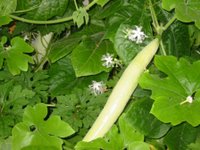
The photo on the right shows dark green yard long beans that grew in my vegetable patch last year. I had planted the imported seeds of a pale green beans but the beans that grew turned out to be dark green.

You will need:
White Yard Long Beans-1 bunch chopped finely
Mustard Seeds-1 tsp
Turmeric-A pinch
Green Chilies-2 slit vertically
Curry leaves- 1 sprig
Grated Coconut-1 1/2 tbsp
Oil-1 1/2 tsp
Salt to taste
Preparation:
1. Heat the oil in a small wok/pan and as it heats up, add mustard seeds and cover till it stops spluttering. Reduce the heat and add the curry leaves and chilies and stir once. Add the beans, salt, turmeric and 1 tbsp water. Cover and cook on medium flame for 5-10 mins till all the beans gets cooked. Open, check seasoning and add the grated coconut, mix and keep covered for a minute. Serve with rice.
Beans Sidedish, Yard Long Beans, Food Blog, Indian Recipes, Vegan
May 11, 2006
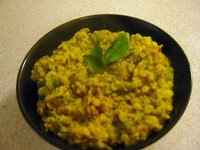
Snake gourd- lentil side dish / Padavalanga Parippu Kootu

Padavalanga or snake gourd is a long dark green vegetable, quite bland on its own but adapts well with different lentils and curries. It goes well in vegetable stew, as a thoran, and as a curry too. As a kid, I was not too fond of it. But last year, I grew it in my vegetable garden and when I tried different recipes with, I could appreciate the versatality of the gourd. This is a side dish which goes well with a rice based menu.
Cooking time:25 mins but preparation time is another 5 mins.
You will need:
Bengal gram /dal(Kadalaparippu) - 1 cup
Oil - 1 tsp
Turmeric powder - 1/2 tsp
Red chilli powder- 1/2 tsp
Snake gourd(Padavalanga) - one
Salt - to taste
Cumin seeds(Jeerakam) - 1 tsp
Green chillies - 4 nos
Small onions/shallots- 3 nos
Garlic pods - 3 nos
Grated coconut - 1/4 cup
For seasoning:
Oil-1 tbsp
Mustard seeds - 1 tsp
Curry leaves - 10 nos
Small onions/shallots- 3 nos
Preparation Method
1. Soak Bengal gram for 15 mins. Wash and scrape the skin lightly.Cut the
vegetable into small pieces.
2. Cook it with the oil, turmeric powder and salt and water. Check every few
minutes to prevent the lentils from sticking to the bottom. The oil prevents
the lentils from excessive frothing. It takes about 20 mins for the lentil to be
fully cooked.( It is fully cooked when the grams stand apart, yet crumble
when you apply pressure.)
3. Simultaneously, cook the gourd with salt, green chillies and turmeric and
enough water to cover it.
4. Dry roast cumin seeds, small onions, garlic and coconut,on slow heat till
it turns light brown. Grind them without adding water.
5. When the snake gourd and lentil are cooked, mix them thoroughly.
6. Add the above paste into the vegetable mixture and cook for another 3
mins.Check for salt and add if needed.
7. Heat 1 tbsp of oil in a pan. Lower the flame. Add the ingredients for
seasoning in the order of mustard seeds, curry leaves and shallots.Fry for
a minute till the shallots turn translucent and add to the snake gourd dish.
Serve with rice.
